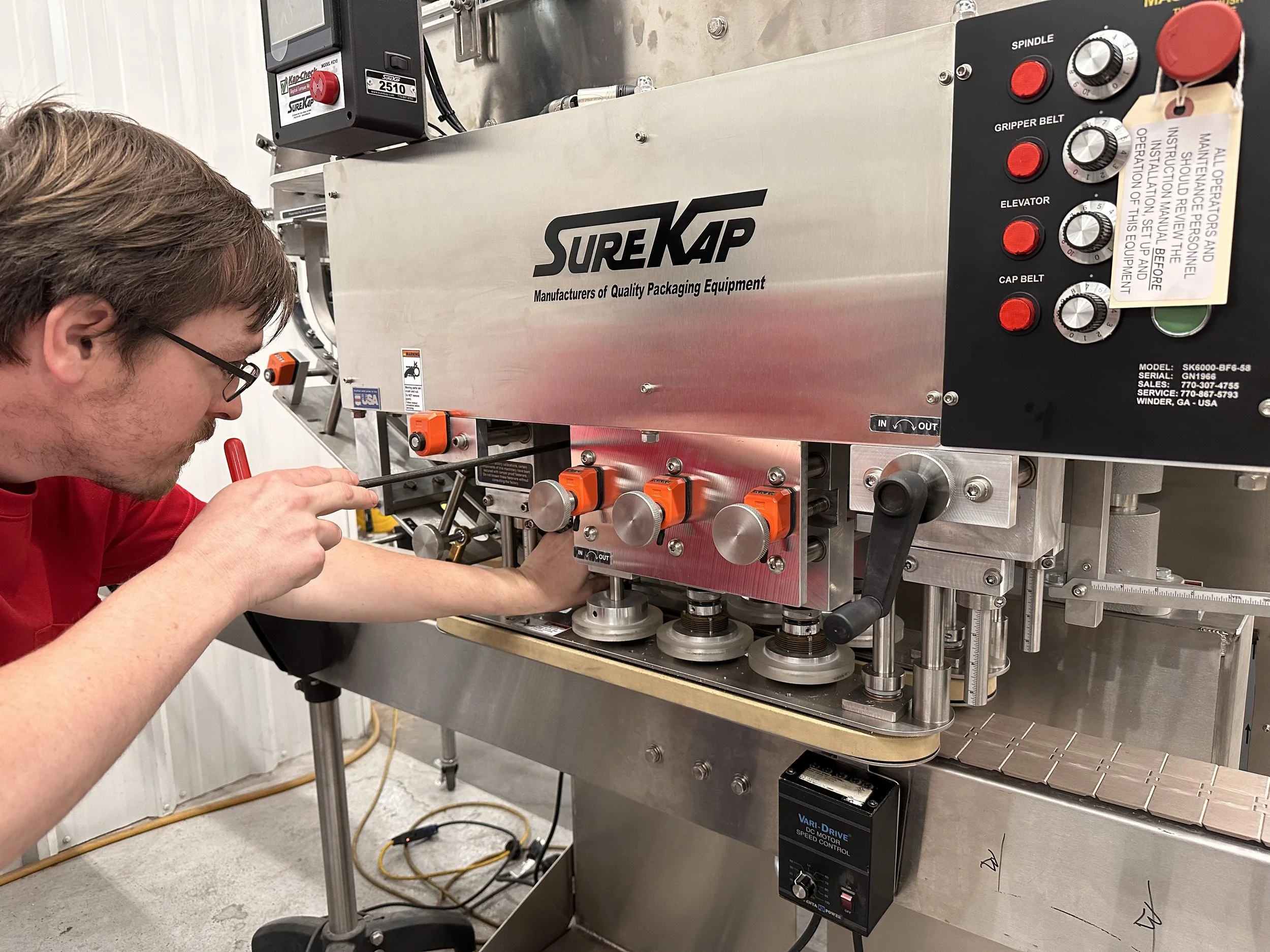
When investing in capping equipment, you know, performance matters. At SureKap, our Applications Testing Process is designed to remove guesswork, validate real-world performance, and provide customers with the tools they need for long-term success.
· We test your product and bottle during the quote process so you know what you are getting with proof that it will work.
· We test your product on your machine, no substitutes.
Let’s outline what our in-house testing process looks like, why it’s important, and how it benefits your operation both at startup and years down the road.
What Applications Testing Does for You
One thing we know from 30+ years in the business is that no two packaging environments are exactly the same. Variations in bottles, caps, materials, and production requirements can significantly impact machine performance.
Applications Testing ensures that:
Your machine is properly matched to your specific container and closure
Performance expectations (speed, consistency, torque) are validated before shipment
Potential issues are identified early, not after installation
Your team receives clear, repeatable setup instructions
Why We Evaluate During Quoting
Testing begins well before a machine is built. In short, testing transforms your machine from a general solution into a dialed-in system built for your exact application.
To guide both machine configuration and the scope of testing required, we analyze:
· Bottle characteristics that we evaluate are shape and profile, height and diameter range, rigidity (soft vs. firm containers) and behavior under pressure (important for gripper belt performance).
· Product characteristics: hot-fill vs. ambient fill conditions
· Cap & Closure aspects, like the type and geometry of the cap, tamper-evident features, thread style (e.g., 400, 410, 415 finishes) and dimensional ranges that may require custom tooling.
· Production capabilities and targets including BPM (bottles per minute) as well as conveyor speeds are all calculated into the solution.
Testing Provides Valuable Documentation
One of the most valuable outputs of our testing process is the Detailed Setup Documentation provided with every machine. We provide this with the machine at shipment, in the equipment manual AND it is available digitally through our service team. It covers:
· Core Machine Settings: machine height, floating shoe height and type, cap chute dimensions (width and height), spindle positions and speeds, gripper belt spacing and speed, and conveyor and cap elevator speeds.
· Application-Specific Adjustments: cap handling settings (sensor timing, belt run duration), tooling selections (flippers, fingers, floating shoes), and material-specific recommendations (e.g., soft vs. rigid bottles).
· Plus we include Quick Change References for customers running multiple SKUs, we provide indexed “quick change” settings that allow operators to switch between formats efficiently and consistently.
Long-Term Value
Our Documentation from testing is not just about initial validation; it becomes a long-term operational asset. When issues arise months or years later, our service team uses the original setup data as a baseline to diagnose problems quickly and accurately. If parts are replaced (belts, discs, tooling), your team can return the machine to its original validated settings with confidence. If you change suppliers or containers, it makes re-testing much easier to ensure new compatibility.
Applications Testing is not just a sales or internal step, it’s a collaboration between SureKap and your team to deliver a reliable, repeatable process you can depend on.
Together, Application Testing ensure a smooth startup and long-term success.