
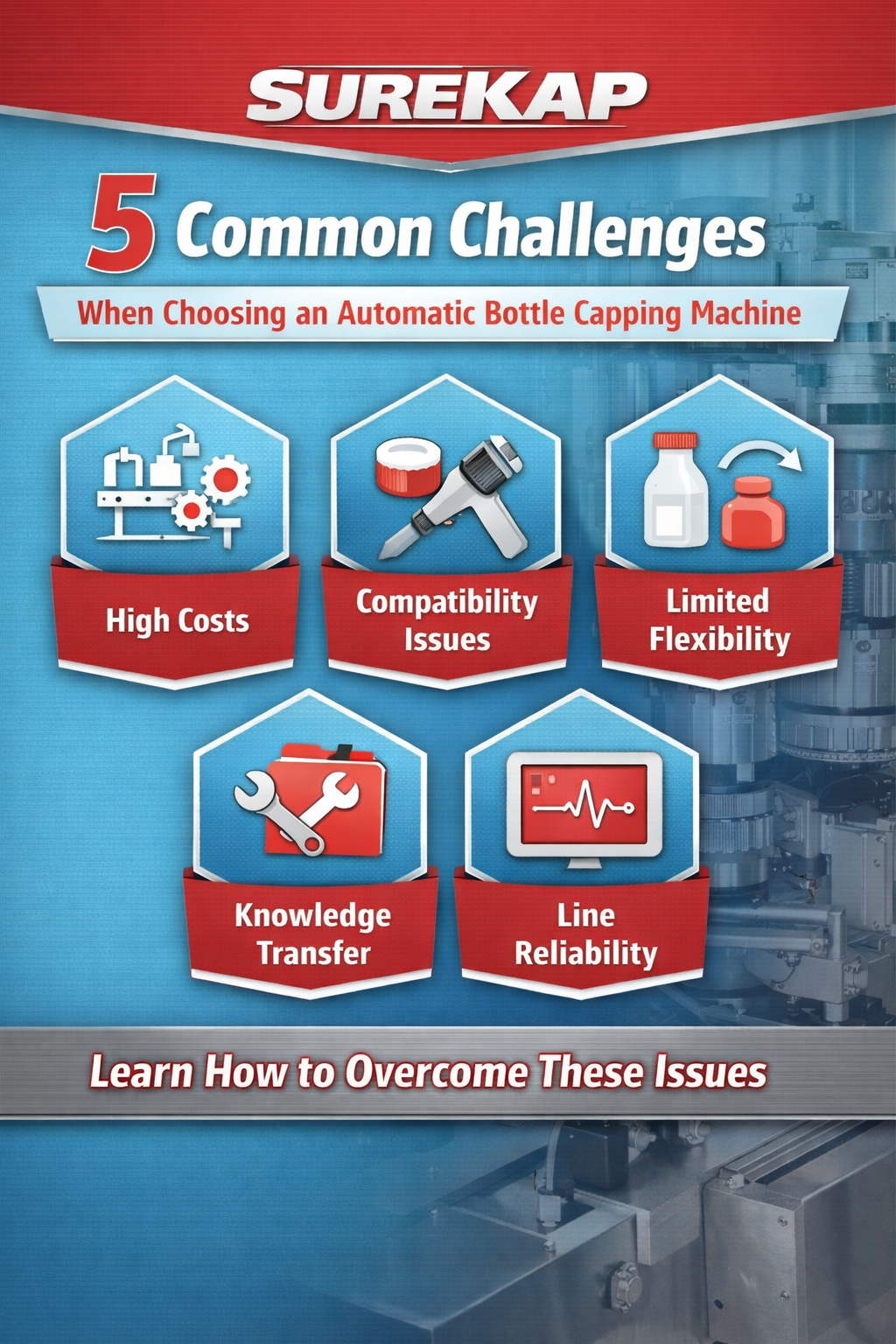
In today’s manufacturing environment, efficiency alone is no longer enough. Packaging teams are under pressure to deliver consistent quality, scale production without disruption or risk while managing changing costs and supply chains. This article is about how to navigate today’s waters if you need new or better Automatic Bottle Capping Machines.
1. Cost Considerations: Looking Beyond the Purchase Price
Cost remains one of the first questions in any capital equipment decision, but in 2026, most of our manufacturers are looking beyond upfront price. The true cost of any Automatic Bottle Capping Machines is realized over years of operation—not at installation.
In addition to the machine itself, buyers must consider training, commissioning, maintenance, spare parts availability, and the cost of downtime if something goes wrong. A lower initial price may carry higher long-term risk if service access is limited or upgrades require major rework. Evaluating total cost of ownership helps ensure the investment aligns with operational goals, production volumes, and long-term growth plans. So let’s look at each of those.
2. Compatibility Challenges: Reducing Integration Risk
A capper must integrate smoothly into existing workflows without introducing bottlenecks, control issues, or layout constraints. Make sure the capping machine you are considering interconnects with your entire line. How to do that?
Compatibility today extends beyond physical footprint. We plan and consider how a capping machine interfaces with upstream fillers, downstream labeling or inspection equipment, and existing control architectures. A valued capping partner will discuss your variations in container size, closure style, and material add complexity, increasing the importance of early evaluation and collaboration with the equipment supplier.
A good partner wants to reduce integration issues upfront as it leads to faster startups, fewer line disruptions, and more predictable performance once production begins. Don’t be pushed to hitting the buy button without this planning.
3. Customization and Flexibility: Planning for What Comes Next
Few production lines stay static. New products, changing volumes, and evolving packaging formats are the norm—not the exception.
We suggest that rather than highly specialized one-off designs, we are seeing manufacturers increasingly prioritize machines that offer adaptability without excessive rework. Features such as adjustable tooling, quick changeovers, and flexible torque control allow a single capping platform to support multiple SKUs or future product launches.
The goal is not customization for its own sake, but for scalability—choosing a solution that can grow with the business while maintaining consistent performance and precision.
4. Training and Integration: Protecting Productivity
Introducing automated equipment requires more than installation—it requires knowledge transfer. While this may seem obvious it is something you can’t overlook. Operators and maintenance teams must be able to run, adjust, and support the machine confidently to avoid unnecessary downtime. We suggest making sure that you look closely at the kind and type of training that is a planned as a part of any capping machine purchase.
Look for: Clear documentation, standardized procedures/process, and structured training to reduce dependence on tribal knowledge and help your teams respond quickly when adjustments are needed. Equally important is access to responsive technical support during startup and beyond. A well-supported machine shortens the learning curve and protects productivity from day one.
We suggest that being here in the USA is critical. It is at least super helpful to training and answering questions as needed for getting and staying up to speed!
5. Reliability and Maintenance: Keeping the Line Running
In a production environment, obviously reliability is non-negotiable. A capping machine must perform consistently, shift after shift, while maintaining closure integrity and product quality.
Manufacturers must evaluate uptime expectations, serviceability, spare parts access, and the supplier’s ability to support the machine over its full lifecycle. Unplanned downtime doesn’t just affect output—it impacts schedules, labor efficiency, and customer commitments.
However do not forget to plan for proactive maintenance planning. We know our durable machine design and a strong service network all contribute to long-term reliability and lower operational risk. We at least think it is worth your time to discuss this issue and make sure you have the right partner to keep you running/profitable.
Choosing the Right Capping Partner
So, not too surprisingly, we feel that partnering with us at SureKap is an option we hope you consider. We focus on precision engineering, machine performance and dependable support. We want to ensure that a capping solution not only meets today’s needs—but continues to perform as production demands evolve. Let us know if we can help.
But no matter who your capping partner is, manufacturers can make more confident decisions to get the overall speed they need. Take the time to consider addressing cost, compatibility, flexibility, training, and reliability through the lens of risk reduction and scalability —speed and profitability follows.
