
How a New Pump/Trigger Sprayer Capping Machine Can Pay for Itself Faster Than You Think
For many growing manufacturers, hand capping starts as a practical solution. It keeps initial costs low, requires little setup, and works well when production volumes are modest.
As demand increases, manual capping often becomes one of the most expensive steps in the production process. The challenge isn't simply labor costs. It's the combination of labor, production limitations, inconsistent torque, operator fatigue, rework, and the inability to increase output without adding people.
When those costs are calculated together, the return on investment for an automated capping system can occur surprisingly fast.
One of the biggest misconceptions about automation is that it requires large production volumes to make financial sense. In reality, many manufacturers are already spending enough on labor to justify automation today.
When the math is viewed over the life of the machine, the conversation shifts from cost to ROI, and in many applications that return starts showing up in about 12-18 months. Read on as we look at the numbers, comparing manual labor with the new VersaKap solution and weighing the risk and value of consistency.
Looking at the Numbers
Consider a manufacturer currently producing 40-50 bottles per minute using a manual or semi-manual capping process. To maintain production, the company assigns three employees to the capping operation.
Assuming a fully burdened labor rate of $25 per hour per employee, here is how the labor cost adds up:
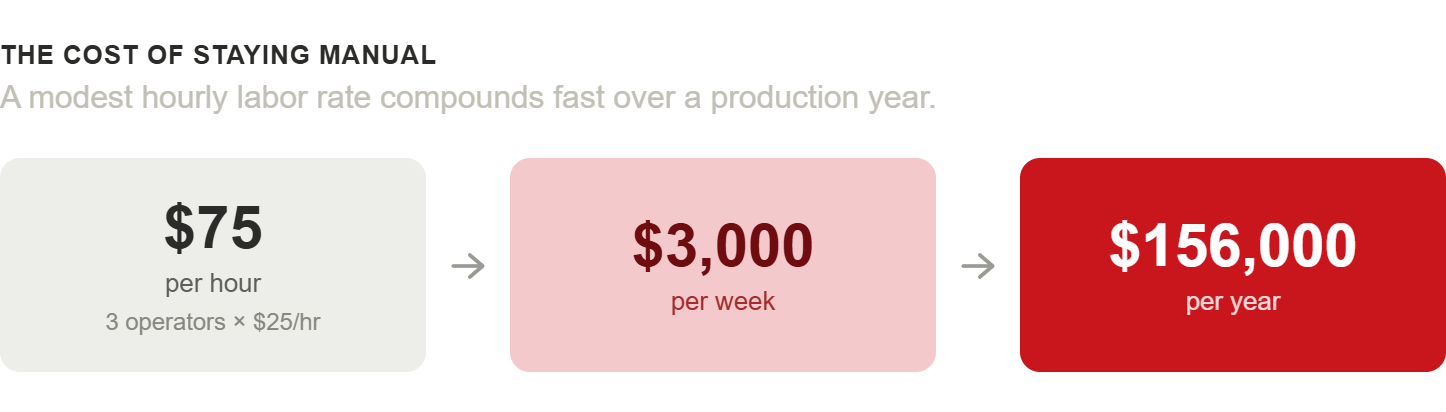
Savings with a VersaKap Machine
A VersaKap automatic capper reduces labor requirements while increasing throughput and improving consistency. Unlike older mechanical cappers, the VersaKap automatically aligns and seats stems and dip tubes, the step that has kept pump, trigger, and sprayer lines on hand assembly. Automating it is what makes the labor savings below possible in the first place.
Let's assume the same manufacturer reduces staffing to one operator while maintaining or increasing production output.
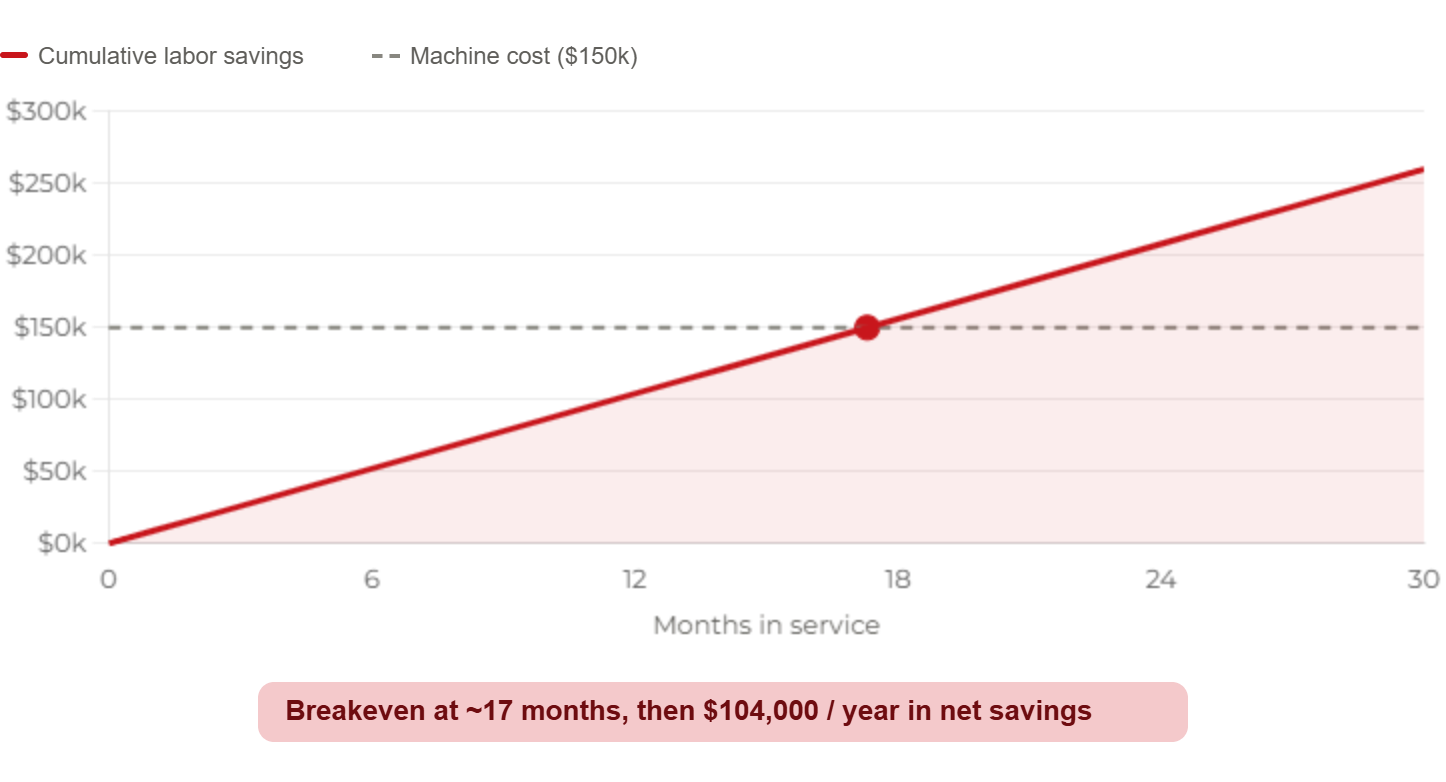
The annual labor savings become:
2 operators eliminated × $25/hour × 40 hours/week × 52 weeks
Annual Savings = $104,000
If the VersaKap investment is approximately $150,000, those savings recover the full machine cost in roughly 17 months through labor alone.
More Bottles Per Minute
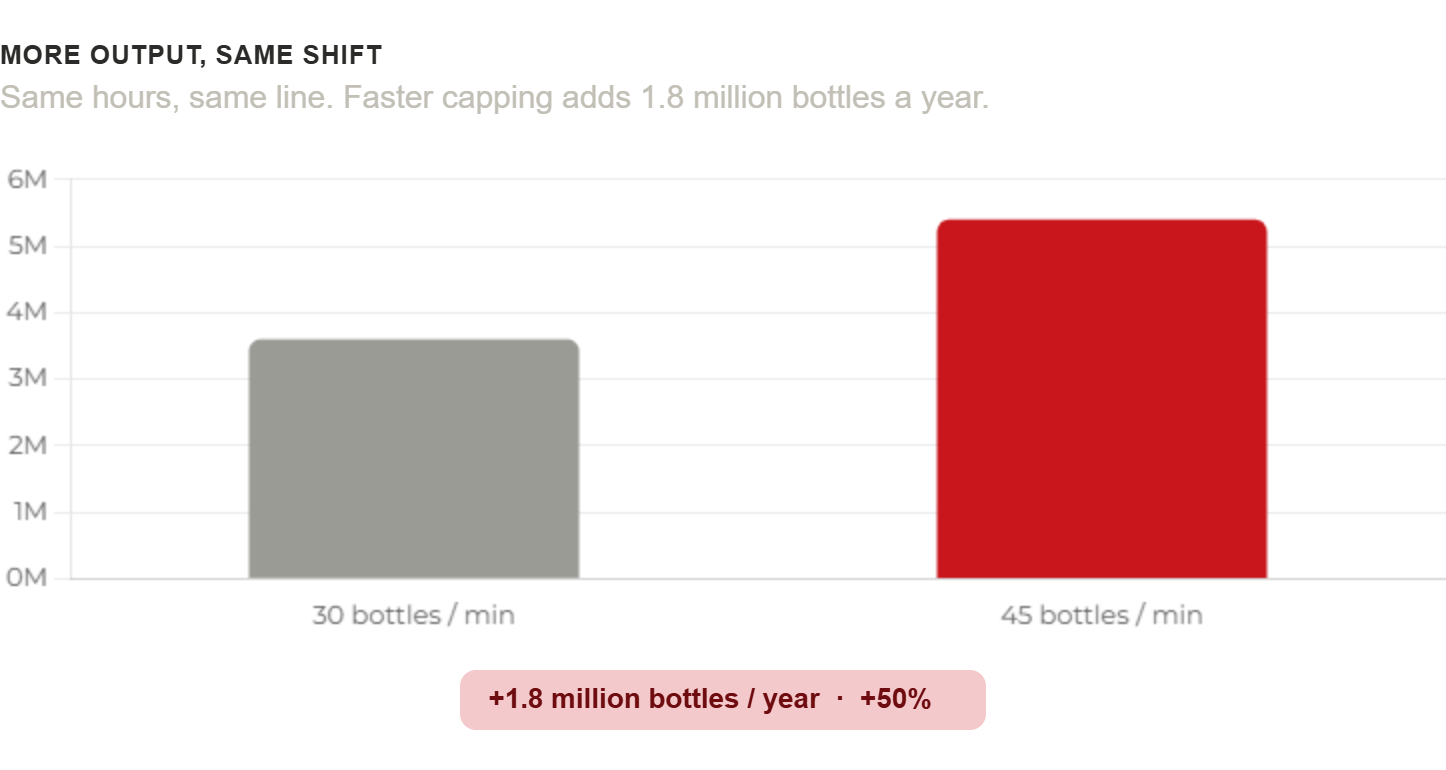
Labor savings are only part of the equation. Many manufacturers purchase automation because they need more production capacity. Instead of running 30 bottles per minute, they may increase output to 40, 50, or even higher speeds depending on the application.
Imagine a company producing:
30 bottles per minute
8 hours per day
250 production days per year
Without adding another shift, extending production hours, or hiring additional operators, the value of added capacity quickly exceeds the labor savings that justified the purchase in the first place.
Reduce Cap Application Risk
Our last point is that every improperly applied cap creates risk and costs money. Loose caps can lead to leaks, damaged product, customer complaints, returns, and wasted production time.
Overtightened caps can create consumer frustration and package damage. Even a small reduction in rejected product can contribute thousands of dollars in annual savings. We know that consistency has financial value, so VersaKap systems are designed to apply consistent torque across production runs, handle alignment of protruding stems, and help reduce variability that commonly occurs with manual processes.
A VersaKap machine doesn't simply replace a manual task. It helps manufacturers increase throughput, improve consistency, reduce labor dependency, and create capacity for future growth.
"Many customers are surprised when they calculate the true cost of manual capping. Once they add up labor savings, increased throughput, and improved consistency are factored in, the payback period is often much shorter than they anticipated."
— Jon Gulley, General Manager, SureKap
Every line runs different caps, bottles, and speeds, so the only payback number that matters is the one built on your situation. Tell us your cap types, bottle specs, and target throughput, and we'll come back with a VersaKap configuration, a line layout, and a quote sized to your production instead of a generic estimate. Contact us to get started.